What Was It Like to Travel on the Oregon Trail
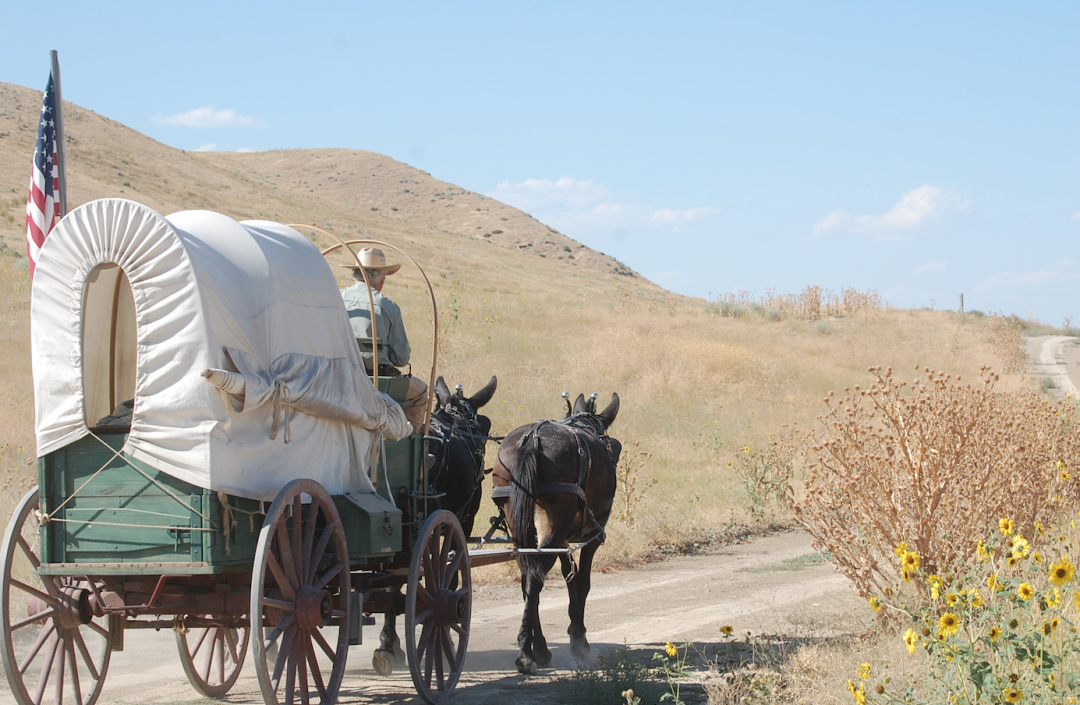
Rinker Buck on the Oregon Trail. (Photo courtesy Rinker Buck)
When Rinker Buck took a route trip in 2010, he didn't simply slip behind the wheel and put his human foot on the gas similar your average American route tripper. Instead, he set off in a 19th century carriage with a team of occasionally cantankerous mules, a Jack Russell chosen Olive Oyl, and his younger brother Nick. Their road? The full length of the Oregon Trail, making them the first to travel it in over a century.
Buck documents the experience in his acclaimed book The Oregon Trail—hailed past the New York Times equally an "arresting" take a chance story, and past the Boston Globe as "charming, big-hearted, impassioned and a lot of fun to read". Ahead of his reading at Powell'due south on Thursday, nosotros caught up with the peripatetic writer to find out why one apparently sane, centre-anile human being would travel over ii,000 miles by railroad vehicle—and what he learned when he did.
What galvanized yous to set off in a covered wagon along a centuries-one-time trail?
It sounds like an adventure tale but it's really more than driven by history. I was in Kansas, working on a journalism story and I came across a trail marking for the Oregon Trail. As a history nut information technology bothered me a lot that I didn't know more almost the trail. Then I started researching it. The thing that'south fascinating about the trail is all the things that they don't tell you in history grade. I wanted to tell the real history of the trail. So in one of the history books I came across this statement that the terminal documented crossing of the trail was 1909. And I thought, why don't I only ride the trail?
Was it hard to make it happen?
My brother and I bought some mules, and over the phone I bought a restored nineteenth century carriage, and it was that simple. Information technology stopped being that simple the day we left.
So things got challenging pretty quickly...
If I'd known all the bug we were going to have and all the things I'd miss and all the problems I was going to accept to solve, we never would have left. The volume is sort of an ode to having a dream and then realizing your dream doesn't make a lot of sense, but to actualize it and follow through on information technology you're merely going to have to improvise. And more important than the land nosotros crossed was learning to alive with dubiousness. So yeah, I still think information technology was pretty crazy, but in that location's a lot to be said for impetuosity.
Were there whatsoever moments along the manner where you genuinely feared for your life?
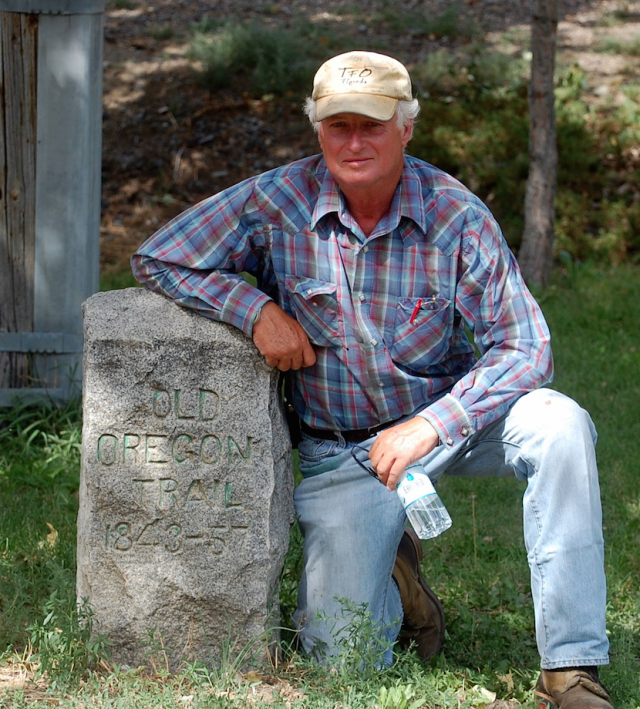
Rinker Buck at an Oregon Trail marking. (Photo courtesy Rinker Buck)
There were a few. A few times we had to take bridges across high water. The rivers were so full and the mules would panic when we got up on top of the bridges, because at that place's nada in their DNA that prepares them for being 150 feet in a higher place the water.
But the single hardest solar day and most precarious time was when we took the end of the Sublette-Greenwood Cutoff which is a section of the trail in Western Wyoming. We took information technology up to viii,300 feet and and so in less than 2 miles we had to descend downwardly a mountainside to 6,000 feet. And then we made a 2,000 foot descent in nigh a mile and a one-half. It was so steep that the mules were and so far below united states, and nosotros had to chain our wheels so that the wagons would skid forth. The wagon was a piddling over five anxiety across and this was all on a trail that was seven feet broad. To the left of u.s. was a 300-foot cliff. And then if annihilation had happened, if the mules had got skittish, nosotros would have gone over the side. That descent took usa about two or iii hours, and the whole style down we were literally one step away from expiry.
How did the post-obit in the literal footsteps of the pioneers change your agreement of the trail's historical context?
All of u.s.a., especially big history readers like me, are creatures of our reading, and I'd always pretty much accepted the idea that Americans were bound to do this, that we were too ambitious and too active—this notion of 'manifest destiny'. But in fact that's non accurate. Many people were homeless because there were successive bank failures, and that collection a lot of people to the trails. Religious rivalries as well became and so unbearable that people but left on the trail because they wanted religious liberty. So those are very unlike motives than 'manifest destiny'. Most of these people were on the trail because they had to be, they were financially drastic or very uncomfortable in their lives.
One day, my brother Nick and I were going along, and it had been a long day, i of those days when the wind was ever in your face, or the mules were a picayune cranky, and nosotros both looked at each other in the wagon seat and said, 'Y'all know, nobody would do this unless they had to. This is too difficult.' That was a big insight, because in one case you lot know that from riding the trail, your agreement of American history becomes dissimilar.
Y'all highlight the stories of a number of characters from history—pioneers who traveled the trail before you and helped shape the story of America. Who were the standouts for you?
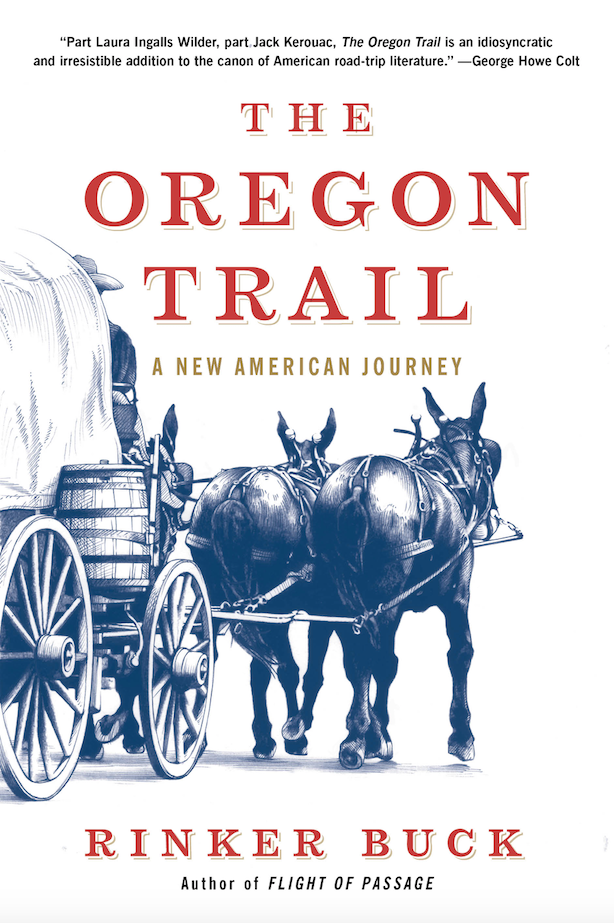
The Oregon Trail
Narcissa Whitman was an evangelist from upstate New York, who decided to become out and 'brainwash the Indians' as far westward as she could get. So she and her husband set off, and she became the outset white woman to cross the Rockies. But she sent abode a series of letters that were published in newspapers, and those letters led to an explosion of traffic on the Oregon trail in much the same way every bit Cheryl Strayed's book Wild has done to the PCT. Whitman had this huge bear on simply she'due south completely forgotten today.
I was also impressed by Abigail Scott and Margaret Frink. They defied the stereotype of women crossing the trail, which was that their husbands had forced them into it and their function was to ride the railroad vehicle all 24-hour interval and hurry the children along. But these pioneer journalists rode across the trail side saddle.
Another character I really loved was named Ezra Meeker—he was the first trail preservationist. He first crossed as a pioneer, made a fortune raising hops, then lost everything and devoted the balance of his life to promoting the preservation of the Oregon Trail. He went out and put stone markers on it, and the fact that the trail ended upward existence preserved and marked—that would never have happened without him.
Early on you divested yourself of many items—vegetable steamers, your ironing spray, fifty-fifty your GPS. What was it like to return to all of these afterward? Did any remain permanently decommissioned?
I think the trip actually had a cleansing effect on me. I'm non as into possessions and living in one place and so forth as I used to exist. I'yard a lot more itinerant now, sort of a vagabond almost, and I detect that I like it. I think the trail gave me coping skills that I was going to need pretty speedily in my life, and information technology taught me not to be and then settled, not and so worried about what my house looks similar . . . just to live.
Rinker Buck reads from The Oregon Trail at Powell's
on Burnside on Thursday, July 31 at 7.30 pm.
grandberrysity1985.blogspot.com
Source: https://www.pdxmonthly.com/arts-and-culture/2015/07/what-s-it-like-to-travel-the-oregon-trail-in-a-mule-led-covered-wagon
0 Response to "What Was It Like to Travel on the Oregon Trail"
Post a Comment