How Does the Doric Ionic and Corinthian Art Look
Today, the remains of Greek cities tin can be institute in Italia, Sicily, and Turkey. Ane of the reasons that they have lasted and so long is that the Greeks built their temples, amphitheaters, and other major public buildings with limestone and marble. Blocks of stone were held in place past bronze or iron pins ready into molten lead — a flexible organisation that could withstand earthquakes.
Greek architecture followed a highly structured system of proportions that relates private architectural components to the whole building. This system was developed according to three styles, or orders.
Each of the orders consists of an upright support called a column that extends from a base at the bottom to a shaft in the middle and a capital at the top — much like the feet, torso, and head of the homo effigy. The capital was oftentimes a stylized representation of natural forms, such as animal horns or establish leaves. It, in turn, supports a horizontal element chosen the entablature, which is divided further into 3 different parts:
- The architrave (everyman part)
- The frieze (middle)
- The cornice (top)
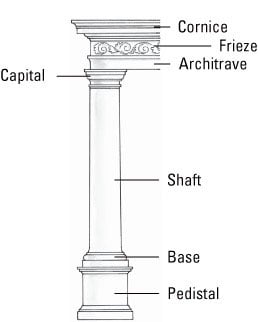
Figure one: Parts of a column.
The Greeks commencement constructed their orders with woods, so switched to stone using the same forms. The ends of the wooden beams belongings up the roof, for example, were translated into stone as a decorative element, called a triglyph ("three grooves"), in the entablature above the column capital.The Greeks started out using only one order per building. Simply after a few hundred years, they got more creative and sometimes used one social club for the outside and another for the interior. The proportions of the orders were adult over a long period of fourth dimension — they became lighter and more than refined.
Some folks think that the orders are primarily a question of details, moldings, and characteristic capitals. Even so, in fact, the very concept of order and an overall relationship is really the most important thing hither. Each of the orders is a proportional system or a range of proportions for the unabridged structure.
Doric: Heavy simplicity
The oldest, simplest, and most massive of the three Greek orders is the Doric, which was applied to temples commencement in the 7th century B.C. As shown in Effigy 2, columns are placed close together and are ofttimes without bases. Their shafts are sculpted with concave curves called flutes. The capitals are apparently with a rounded section at the bottom, known as the echinus, and a square at the top, called the abacus. The entablature has a distinctive frieze decorated with vertical channels, or triglyphs. In betwixt the triglyphs are spaces, chosen metopes, which were ordinarily sculpted with figures and ornamentation. The frieze is separated from the architrave past a narrow band called the regula. Together, these elements formed a rectangular structure surrounded by a double row of columns that conveyed a bold unity. The Doric order reached its top of perfection in the Parthenon. 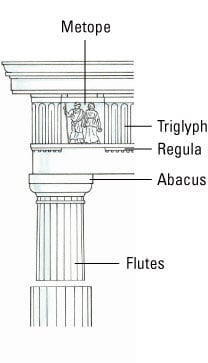
Figure two: Doric order.
Ionic: Await for the 2 scrolls
The next order to exist developed by the Greeks was the Ionic (see Figure 3). Information technology is called Ionic because it developed in the Ionian islands in the sixth century B.C. Roman historian Vitruvius compared this delicate order to a female grade, in contrast to the stockier "male person" Doric club.The Ionic was used for smaller buildings and interiors. It'due south piece of cake to recognize because of the two scrolls, chosen volutes, on its capital. The volutes may have been based on nautilus shells or fauna horns.
Between the volutes is a curved department that is often carved with oval decorations known as egg and dart. Above the capital, the entablature is narrower than the Doric, with a frieze containing a continuous band of sculpture. One of the primeval and nigh striking examples of the Ionic lodge is the tiny Temple to Athena Nike at the archway to the Athens Acropolis. It was designed and built by Callicrates from about 448-421 B.C.
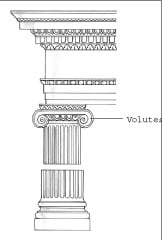
Figure iii: Ionic order.
Corinthian: Leafy merely not equally popular
The third guild is the Corinthian, which wasn't used much by the Greeks. It is named after the metropolis of Corinth, where sculptor Callimachus supposedly invented it by at the end of the 5th century B.C. after he spotted a goblet surrounded past leaves. As shown in Figure 4, the Corinthian is similar to the Ionic order in its base, column, and entablature, just its capital is far more ornate, carved with two tiers of curly acanthus leaves. The oldest known Corinthian column stands inside the 5th-century temple of Apollo Epicurius at Bassae. 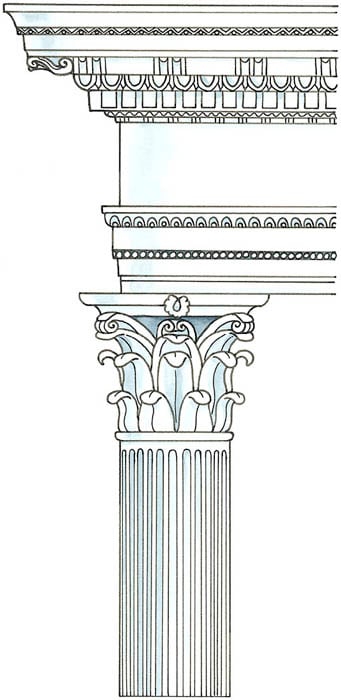
Figure four: Corinthian order.
Compensating for illusions: Straight or curved, who knew?
The Greeks connected to strive for perfection in the advent of their buildings. To make their columns expect directly, they bowed them slightly outward to compensate for the optical illusion that makes vertical lines look curved from a distance. They named this effect entasis, which means "to strain" in Greek.
Relationships between columns, windows, doorways, and other elements were constantly analyzed to find pleasing dimensions that were in harmony with nature and the man body. Symmetry and the unity of parts to the whole were of import to Greek architecture, as these elements reflected the democratic city-land pioneered by the Greek civilization.About This Article
This article is from the book:
- Architecture For Dummies ,
This article tin can be constitute in the category:
- Compages ,
grandberrysity1985.blogspot.com
Source: https://www.dummies.com/article/academics-the-arts/art-architecture/architecture/greek-architecture-doric-ionic-or-corinthian-201218/
0 Response to "How Does the Doric Ionic and Corinthian Art Look"
Post a Comment