Finding Angles and Sides of a Right Triangle When All You Know Is the Hypotenuse
Right Triangles and the Pythagorean Theorem
The Pythagorean Theorem, [latex]{\displaystyle a^{2}+b^{2}=c^{2},}[/latex] tin be used to notice the length of whatsoever side of a right triangle.
Learning Objectives
Use the Pythagorean Theorem to find the length of a side of a right triangle
Key Takeaways
Key Points
- The Pythagorean Theorem, [latex]{\displaystyle a^{2}+b^{2}=c^{two},}[/latex] is used to notice the length of whatsoever side of a correct triangle.
- In a right triangle, one of the angles has a value of 90 degrees.
- The longest side of a right triangle is called the hypotenuse, and it is the side that is opposite the ninety degree bending.
- If the length of the hypotenuse is labeled [latex]c[/latex], and the lengths of the other sides are labeled [latex]a[/latex] and [latex]b[/latex], the Pythagorean Theorem states that [latex]{\displaystyle a^{2}+b^{2}=c^{2}}[/latex].
Key Terms
- legs: The sides adjacent to the right bending in a correct triangle.
- right triangle: A [latex]3[/latex]-sided shape where one angle has a value of [latex]90[/latex] degrees
- hypotenuse: The side opposite the right angle of a triangle, and the longest side of a correct triangle.
- Pythagorean theorem: The sum of the areas of the 2 squares on the legs ([latex]a[/latex] and [latex]b[/latex]) is equal to the area of the foursquare on the hypotenuse ([latex]c[/latex]). The formula is [latex]a^2+b^2=c^ii[/latex].
Right Triangle
A correct bending has a value of xc degrees ([latex]90^\circ[/latex]). A right triangle is a triangle in which 1 bending is a right angle. The relation between the sides and angles of a right triangle is the basis for trigonometry.
The side opposite the right bending is chosen the hypotenuse (side [latex]c[/latex] in the effigy). The sides side by side to the correct bending are called legs (sides [latex]a[/latex] and [latex]b[/latex]). Side [latex]a[/latex] may be identified every bit the side adjacent to angle [latex]B[/latex] and opposed to (or reverse) bending [latex]A[/latex]. Side [latex]b[/latex] is the side next to bending [latex]A[/latex] and opposed to angle [latex]B[/latex].
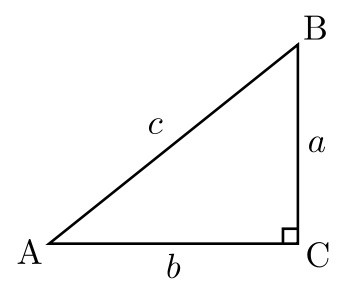
Right triangle: The Pythagorean Theorem tin be used to find the value of a missing side length in a right triangle.
If the lengths of all three sides of a right triangle are whole numbers, the triangle is said to be a Pythagorean triangle and its side lengths are collectively known equally a Pythagorean triple.
The Pythagorean Theorem
The Pythagorean Theorem, as well known as Pythagoras' Theorem, is a fundamental relation in Euclidean geometry. It defines the relationship among the three sides of a right triangle. It states that the foursquare of the hypotenuse (the side opposite the right bending) is equal to the sum of the squares of the other two sides. The theorem tin can exist written as an equation relating the lengths of the sides [latex]a[/latex], [latex]b[/latex] and [latex]c[/latex], ofttimes chosen the "Pythagorean equation":[one]
[latex]{\displaystyle a^{2}+b^{2}=c^{ii}} [/latex]
In this equation, [latex]c[/latex] represents the length of the hypotenuse and [latex]a[/latex] and [latex]b[/latex] the lengths of the triangle'south other two sides.
Although it is often said that the noesis of the theorem predates him,[2] the theorem is named after the ancient Greek mathematician Pythagoras (c. 570 – c. 495 BC). He is credited with its first recorded proof.
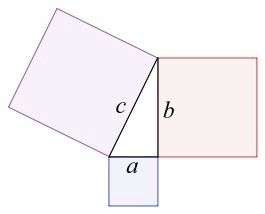
The Pythagorean Theorem: The sum of the areas of the 2 squares on the legs ([latex]a[/latex] and [latex]b[/latex]) is equal to the area of the square on the hypotenuse ([latex]c[/latex]). The formula is [latex]a^two+b^2=c^ii[/latex].
Finding a Missing Side Length
Example 1: A right triangle has a side length of [latex]x[/latex] feet, and a hypotenuse length of [latex]xx[/latex] feet. Find the other side length. (round to the nearest tenth of a foot)
Substitute [latex]a=10[/latex] and [latex]c=xx[/latex] into the Pythagorean Theorem and solve for [latex]b[/latex].
[latex]\displaystyle{ \brainstorm{align} a^{2}+b^{two} &=c^{two} \\ (10)^2+b^two &=(xx)^ii \\ 100+b^2 &=400 \\ b^two &=300 \\ \sqrt{b^2} &=\sqrt{300} \\ b &=17.3 ~\mathrm{feet} \terminate{align} }[/latex]
Example 2: A correct triangle has side lengths [latex]3[/latex] cm and [latex]four[/latex] cm. Find the length of the hypotenuse.
Substitute [latex]a=iii[/latex] and [latex]b=4[/latex] into the Pythagorean Theorem and solve for [latex]c[/latex].
[latex]\displaystyle{ \begin{align} a^{2}+b^{two} &=c^{2} \\ 3^2+four^2 &=c^ii \\ nine+16 &=c^2 \\ 25 &=c^2\\ c^2 &=25 \\ \sqrt{c^2} &=\sqrt{25} \\ c &=5~\mathrm{cm} \end{align} }[/latex]
How Trigonometric Functions Work
Trigonometric functions can be used to solve for missing side lengths in right triangles.
Learning Objectives
Recognize how trigonometric functions are used for solving problems almost right triangles, and identify their inputs and outputs
Key Takeaways
Key Points
- A right triangle has one angle with a value of 90 degrees ([latex]xc^{\circ}[/latex])The three trigonometric functions most often used to solve for a missing side of a right triangle are: [latex]\displaystyle{\sin{t}=\frac {opposite}{hypotenuse}}[/latex], [latex]\displaystyle{\cos{t} = \frac {adjacent}{hypotenuse}}[/latex], and [latex]\displaystyle{\tan{t} = \frac {opposite}{side by side}}[/latex]
Trigonometric Functions
We tin can define the trigonometric functions in terms an bending [latex]t[/latex] and the lengths of the sides of the triangle. The adjacent side is the side closest to the bending. (Adjacent ways "adjacent to.") The opposite side is the side beyond from the angle. The hypotenuse is the side of the triangle opposite the correct angle, and it is the longest.
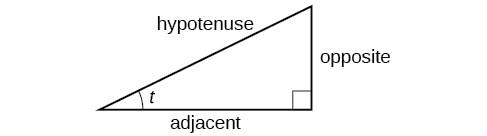
Right triangle: The sides of a right triangle in relation to angle [latex]t[/latex].
When solving for a missing side of a right triangle, simply the just given data is an acute angle measurement and a side length, employ the trigonometric functions listed below:
- Sine [latex]\displaystyle{\sin{t} = \frac {opposite}{hypotenuse}}[/latex]
- Cosine [latex]\displaystyle{\cos{t} = \frac {adjacent}{hypotenuse}}[/latex]
- Tangent [latex]\displaystyle{\tan{t} = \frac {opposite}{next}}[/latex]
The trigonometric functions are equal to ratios that relate certain side lengths of a right triangle. When solving for a missing side, the first step is to identify what sides and what angle are given, and then select the appropriate function to use to solve the problem.
Evaluating a Trigonometric Function of a Right Triangle
Sometimes you lot know the length of one side of a triangle and an angle, and demand to find other measurements. Use 1 of the trigonometric functions ([latex]\sin{}[/latex], [latex]\cos{}[/latex], [latex]\tan{}[/latex]), identify the sides and angle given, set upwards the equation and use the calculator and algebra to find the missing side length.
Instance 1:
Given a right triangle with acute angle of [latex]34^{\circ}[/latex] and a hypotenuse length of [latex]25[/latex] anxiety, detect the length of the side opposite the acute bending (round to the nearest tenth):
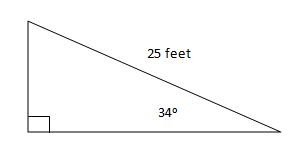
Right triangle: Given a right triangle with astute angle of [latex]34[/latex] degrees and a hypotenuse length of [latex]25[/latex] feet, observe the opposite side length.
Looking at the figure, solve for the side opposite the acute angle of [latex]34[/latex] degrees. The ratio of the sides would exist the opposite side and the hypotenuse. The ratio that relates those two sides is the sine function.
[latex]\displaystyle{ \begin{align} \sin{t} &=\frac {opposite}{hypotenuse} \\ \sin{\left(34^{\circ}\right)} &=\frac{x}{25} \\ 25\cdot \sin{ \left(34^{\circ}\correct)} &=x\\ ten &= 25\cdot \sin{ \left(34^{\circ}\right)}\\ x &= 25 \cdot \left(0.559\dots\correct)\\ ten &=fourteen.0 \end{align} }[/latex]
The side contrary the acute bending is [latex]14.0[/latex] feet.
Example 2:
Given a right triangle with an astute angle of [latex]83^{\circ}[/latex] and a hypotenuse length of [latex]300[/latex] feet, find the hypotenuse length (circular to the nearest 10th):
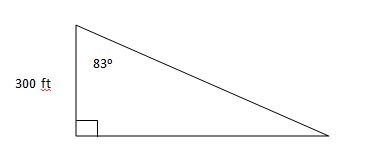
Right Triangle: Given a right triangle with an astute angle of [latex]83[/latex] degrees and a hypotenuse length of [latex]300[/latex] anxiety, find the hypotenuse length.
Looking at the figure, solve for the hypotenuse to the acute bending of [latex]83[/latex] degrees. The ratio of the sides would be the adjacent side and the hypotenuse. The ratio that relates these 2 sides is the cosine office.
[latex]\displaystyle{ \begin{align} \cos{t} &= \frac {adjacent}{hypotenuse} \\ \cos{ \left( 83 ^{\circ}\right)} &= \frac {300}{x} \\ x \cdot \cos{\left(83^{\circ}\correct)} &=300 \\ ten &=\frac{300}{\cos{\left(83^{\circ}\right)}} \\ ten &= \frac{300}{\left(0.1218\dots\right)} \\ ten &=2461.7~\mathrm{feet} \cease{align} }[/latex]
Sine, Cosine, and Tangent
The mnemonic
SohCahToa can be used to solve for the length of a side of a correct triangle.
Learning Objectives
Apply the acronym SohCahToa to ascertain Sine, Cosine, and Tangent in terms of right triangles
Key Takeaways
Fundamental Points
- A common mnemonic for remembering the relationships between the Sine, Cosine, and Tangent functions is SohCahToa.
- SohCahToa is formed from the first letters of "Sine is opposite over hypotenuse (Soh), Cosine is adjacent over hypotenuse (Cah), Tangent is reverse over adjacent (Toa)."
Definitions of Trigonometric Functions
Given a right triangle with an acute angle of [latex]t[/latex], the first three trigonometric functions are:
- Sine [latex]\displaystyle{ \sin{t} = \frac {opposite}{hypotenuse} }[/latex]
- Cosine [latex]\displaystyle{ \cos{t} = \frac {adjacent}{hypotenuse} }[/latex]
- Tangent [latex]\displaystyle{ \tan{t} = \frac {opposite}{next} }[/latex]
A mutual mnemonic for remembering these relationships is SohCahToa, formed from the first letters of "Sine is opposite over hypotenuse (Soh), Cosine is adjacent over hypotenuse (Cah), Tangent is reverse over side by side (Toa)."
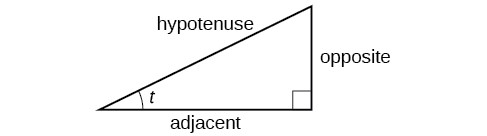
Right triangle: The sides of a right triangle in relation to angle [latex]t[/latex]. The hypotenuse is the long side, the opposite side is across from angle [latex]t[/latex], and the adjacent side is adjacent to angle [latex]t[/latex].
Evaluating a Trigonometric Function of a Right Triangle
Example 1:
Given a correct triangle with an acute bending of [latex]62^{\circ}[/latex] and an adjacent side of [latex]45[/latex] feet, solve for the contrary side length. (circular to the nearest tenth)
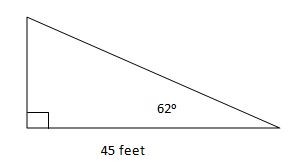
Right triangle: Given a right triangle with an acute bending of [latex]62[/latex] degrees and an adjacent side of [latex]45[/latex] feet, solve for the reverse side length.
First, determine which trigonometric function to use when given an next side, and you need to solve for the contrary side. E'er make up one's mind which side is given and which side is unknown from the acute angle ([latex]62[/latex] degrees). Remembering the mnemonic, "SohCahToa", the sides given are opposite and adjacent or "o" and "a", which would use "T", meaning the tangent trigonometric function.
[latex]\displaystyle{ \begin{align} \tan{t} &= \frac {opposite}{adjacent} \\ \tan{\left(62^{\circ}\right)} &=\frac{10}{45} \\ 45\cdot \tan{\left(62^{\circ}\right)} &=ten \\ x &= 45\cdot \tan{\left(62^{\circ}\right)}\\ x &= 45\cdot \left( 1.8807\dots \right) \\ x &=84.6 \end{align} }[/latex]
Example 2: A ladder with a length of [latex]30~\mathrm{anxiety}[/latex] is leaning confronting a building. The angle the ladder makes with the ground is [latex]32^{\circ}[/latex]. How high up the building does the ladder reach? (round to the nearest 10th of a foot)
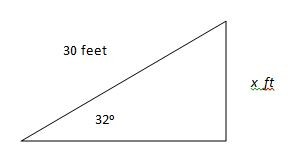
Right triangle: After sketching a picture of the problem, we have the triangle shown. The bending given is [latex]32^\circ[/latex], the hypotenuse is 30 anxiety, and the missing side length is the opposite leg, [latex]x[/latex] feet.
Decide which trigonometric function to utilise when given the hypotenuse, and you lot need to solve for the contrary side. Remembering the mnemonic, "SouthohCahToa", the sides given are the hypotenuse and contrary or "h" and "o", which would utilise "S" or the sine trigonometric part.
[latex]\displaystyle{ \brainstorm{marshal} \sin{t} &= \frac {opposite}{hypotenuse} \\ \sin{ \left( 32^{\circ} \right) } & =\frac{10}{30} \\ 30\cdot \sin{ \left(32^{\circ}\correct)} &=x \\ ten &= 30\cdot \sin{ \left(32^{\circ}\right)}\\ x &= 30\cdot \left( 0.5299\dots \right) \\ x &= 15.9 ~\mathrm{feet} \end{align} }[/latex]
Finding Angles From Ratios: Inverse Trigonometric Functions
The inverse trigonometric functions can be used to find the acute angle measurement of a right triangle.
Learning Objectives
Use inverse trigonometric functions in solving problems involving correct triangles
Key Takeaways
Key Points
- A missing acute angle value of a right triangle tin be found when given ii side lengths.
- To find a missing angle value, use the trigonometric functions sine, cosine, or tangent, and the changed key on a reckoner to utilise the inverse function ([latex]\arcsin{}[/latex], [latex]\arccos{}[/latex], [latex]\arctan{}[/latex]), [latex]\sin^{-1}[/latex], [latex]\cos^{-ane}[/latex], [latex]\tan^{-1}[/latex].
Using the trigonometric functions to solve for a missing side when given an acute angle is every bit simple every bit identifying the sides in relation to the astute angle, choosing the correct function, setting upwards the equation and solving. Finding the missing astute angle when given two sides of a right triangle is merely equally uncomplicated.
Changed Trigonometric Functions
In social club to solve for the missing astute bending, use the same iii trigonometric functions, just, use the inverse key ([latex]^{-ane}[/latex]on the figurer) to solve for the angle ([latex]A[/latex]) when given two sides.
[latex]\displaystyle{ A^{\circ} = \sin^{-1}{ \left( \frac {\text{reverse}}{\text{hypotenuse}} \right) } }[/latex]
[latex]\displaystyle{ A^{\circ} = \cos^{-1}{ \left( \frac {\text{adjacent}}{\text{hypotenuse}} \right) } }[/latex]
[latex]\displaystyle{ A^{\circ} = \tan^{-one}{\left(\frac {\text{opposite}}{\text{adjacent}} \right) }}[/latex]
Example
For a correct triangle with hypotenuse length [latex]25~\mathrm{anxiety}[/latex] and acute angle [latex]A^\circ[/latex]with reverse side length [latex]12~\mathrm{feet}[/latex], notice the acute bending to the nearest degree:
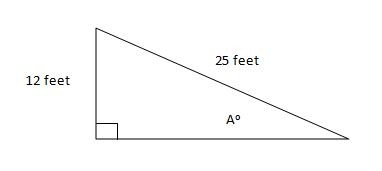
Right triangle: Detect the measure of angle [latex]A[/latex], when given the reverse side and hypotenuse.
From angle [latex]A[/latex], the sides opposite and hypotenuse are given. Therefore, employ the sine trigonometric function. (Soh from SohCahToa) Write the equation and solve using the inverse key for sine.
[latex]\displaystyle{ \begin{align} \sin{A^{\circ}} &= \frac {\text{reverse}}{\text{hypotenuse}} \\ \sin{A^{\circ}} &= \frac{12}{25} \\ A^{\circ} &= \sin^{-1}{\left( \frac{12}{25} \correct)} \\ A^{\circ} &= \sin^{-1}{\left( 0.48 \correct)} \\ A &=29^{\circ} \cease{align} }[/latex]
grandberrysity1985.blogspot.com
Source: https://courses.lumenlearning.com/boundless-algebra/chapter/trigonometry-and-right-triangles/
0 Response to "Finding Angles and Sides of a Right Triangle When All You Know Is the Hypotenuse"
Post a Comment